top of page
.png)

Mixed fiber material
From textile waste to fiber pellets
Mixed textiles are prevalent in sportswear, creating a recycling challenge that often leads to landfill or incineration. It was also important to find a valuable process to reintroduce the textiles into their products. To address this issue, we've developed a pellet solutions for clothing brands, reintegrating discarded textile back into the product cycle while delivering a compelling story to their customers, creating a strong connection between brand and conscious consumers.
From Mixed Fibers to Injection Grade Pellets
Engaging with key stakeholders in the fashion and textile industry, now constrained by new EU regulations on mixed textile waste disposal, has increased our ambition to transcend basic recycling practices. We should always aim for fiber-to-fiber solutions whenever possible, but it requires a consistent stream of mono-materials of high quality, which is rarely the case. We were therefore being challenged finding alternative processes where mixed fibers can be incorporated, both organic and synthetic sources.
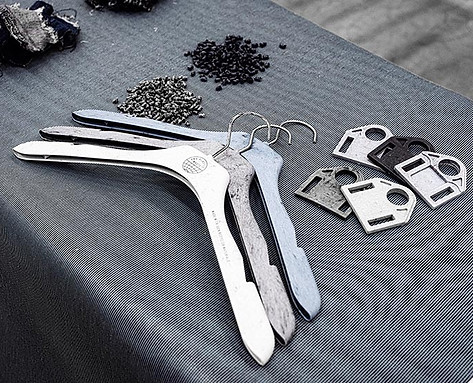
Material development process
Mixed fabrics can be introduced into a composite material for injection molding. The fabrics are shredded and used as a strengthening fiber in the material. As the pellets can be applied directly to industrial scale injection molding machines, the products can be produced quickly and cost effectively. Obsolete clothing can also be used.


Waste collection
Collecting non-reusable mixed textile waste from post-consumer streams
Waste processing
Materials are sorted by type and color, and cleaned of contamination
Fiber opening
The textile is going through a fibre opening process using mechanical shredding
Fiber pellets
The fibers are processed into smaller pellets of 100% recycled fibers.
Part production
The fibers are compounded and injection molded into new products.
Product outcome
In store hangers
The industry's first Circular Hanger, made entirely from 100% recycled materials and completely recyclable. These hangers are designed for circularity, meaning that at the end of their lifecycle, they are collected, reground, and reinjected into the manufacturing process to create new hangers, being a true closed-loop solution.


bottom of page